Tom has no problem gritting it out on a boulder:
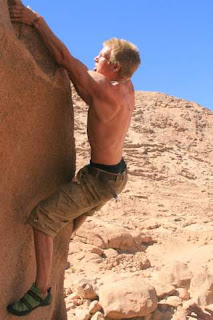 Aidan tries to get some help from his feet:
It was a shame, really, because there is massive potential for climbing on the granite mountains that fight for space in the area, many of which have barely been explored by modern climbers (although a handful of people have climbed in the area, Dave Lucas, a former Hot Rocker, has spent the past few years trying to develop the region in an effort to make it a viable climbing tourist destination).
Typical views:
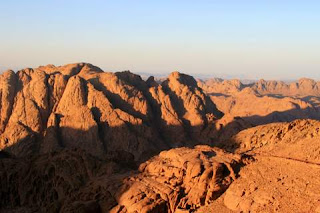

I say modern climbers because the Bedouins have "paths" -- many of which require trad gear by today's standards -- they have used for centuries to criss-cross the mountains. It is humbling to realize that a population made their way up and over countless granite domes without the helmets, ropes, harnesses, climbing shoes, and extensive trad gear that we deem necessary today.
One day, Duncan and I finished an 11 pitch climb on the later side of sunset and still needed to find our way back down the mountain. Luckily for me and the meager light from my headlamp (I really did mean to change the batteries), the rock glowed blue-white in the full moon, making it possible to navigate solely by eyesite. Although we didn't make it back to camp until close to 9:30 p.m., we had an amazing descent along one of the Bedouin paths which just happened to be haphazardly marked with cairns. We made our way down one gulley, which, on a few occasions, appeared to drop away from us, neccessitating leaving some gear for an abseil. We knew full well that people had used the route before us, however, and they certainly didn't have any modern gear. Sometimes it took us a good 20 minutes, but eventually we would find a small hole or cave formed by water we could squeeze through that would double-back underground, sometime taking us from one side of the gulley to the other, leading eventually to an exit point from which we were able to downclimb. It was a magical and exhausting evening. Later, Duncan happened to talk to one Bedouin who knew of the gulley path and said that it was no longer in use. We very well may have been the first people to use it in years.
There are other paths, though, that are heavily used year-round. Day-tripping tourist come from all over to hike up the trails to the top of Mt. Sinai. Yes, that is The Mt. Sinai of Moses fame. Although we had all heard horror stories of hundreds of tourists bussed in at 2 a.m. to climb the mountain in order to view sunrise, they apparently avoided sunset like the plague. Seems a bit silly, really, since sunrise and sunset can be equally spectacular,
Sunset from the top of Mt. Sinai:

and one is either hiking up in the dark or hiking down in the dark.
Even more to the point, starting the hike during daylight would probably take care of one of the biggest problems for tour operators: injuries. I spoke with an Israeli tour operator that was staying at our camp one day and she said that they had a serious issue with people becoming so excited that they literally rushed the mountain in a religious fervor. Now, ordinarily, a little excitement is a good thing, but not when the majority of clients tend to be the kind that have exercised a total of three minutes in the past few decades. Apparently, broken legs, head injuries, and even heart attacks were common occurences. And that's just in the first few hundred meters which are relatively flat, well-travelled trails. Needless to say, I decided at that moment never to become a tour operator.
I did, however, decide to make a sunset assault on Mt. Sinai. It was fantastic. Other than the multitude of huts along the way selling everything from Snickers Bars to freshly brewed tea, that is. I pretend to be extremely annoyed by their presence, but what did I do upon descending from the top? Buy some tea. Lack of self-control aside, Gail, Juliet, Nathan, and I all had a great time watching the sunset from the top of Mt. Sinai.
Church at the top. There was also a mosque and a synagogue:
It was beautiful and there were maybe 10 other people on top so we could take ridiculous pictures without suffering ridicule.
Gail, Juliet, and Nathan claw their way to the summit: With so much sweat pouring down my body, I decide to position myself between Gail and Nathan in an effort to look normal:
 Me attempting to boulder at the summit:
 Well, we are in Egypt, after all...:
And eat Twinkies until we felt like throwing up (for some reason, Twinkies are unbelievably cheap in Egypt).
Juliet enjoys some additives and preservatives while Gail and Nathan try not to look famished:
Food in general is actually quite cheap in Egypt. We took a break from climbing to go to Dahab, a tourist town on the coast, for a couple of days, and wound up eating ourselves silly. We chose one lucky restaurant, Al Capone, purely because it was close to where we were staying and they were giving us a deal on thick shakes. I had no idea how good a milkshake would taste until I went eight months without one. It turned out to be a win-win situation because we literally stayed at the restaurant for eight solid hours each day eating. I've never, ever done that in my life. The closest I've come have been my multi-hour dinner visits to The French Laundry (I still have dreams about those meals...), but those visits put an obscene dent in my wallet. At Al Capone, we could eat and talk and eat and laugh and eat and nap and eat all day and it was still only the cost of a $10-dollar lunch in San Francisco. You know that you are a valued customer when the owner offers you floor space to pitch your tent. We seriously considered the offer because they had exceptionally nice bathrooms. You have no idea what a novelty that can become. The fact that I lost both my small camera and watch in Dahab does nothing to marr the fond eating memories I have there. Does that mean I have a problem?
After yet another gorge-fest in yet another African country, it was time to climb off some calories. Danny had managed to set up a three-day climbing trip with camels as pack animals that would take us out into the desert through a Bedouin friend of Dave Lucas, Nassar.
Man, myth, legend; it's Nassar: Nassar takes a moment with his camel, Schnapps:
For some serious mate's rates, we hiked over a mountain,  Danny and Nassar discuss bringing oxygen for the group next time:
past a small oasis or two,  Nassar knocks down fresh almonds for us:
 House near an oasis:
and past some opium fields (gardens, really)
The group trudges by soom blooming poppies. Note the black irrigation hoses: Opium! Needless to say, it is not a good idea to go wandering off without a known guide unless you want to meet up with guys carrying machine guns protecting their crop:

into a small river gulley next to a mountain surrounded by virtually unclimbed peaks. Sunset from camp:
It was unreal. Not just because Nassar whipped up amazing meals at the drop of a hat -- including bread baked in ashes one day and over the fire the next --  Nassar could also whip up a pot of tea in 5 minutes flat including the time it takes to start the fire:
but also because it was an exceptionally beautiful place full of great climbing. Danny and I had issues initially trying to find suitable routes, but eventually he drug me up a couple of previously unclimbed cracks which scared the crap out of me.
Uh, Danny, you need to turn around:
It was such a great vibe to be out in the middle of nowhere with great friends, great food, and fall asleep to the sound of camels chewing cud.
Or, in Aidan's case, wake up to the sound of a camel chewing cud:
Clean camel saddles before we set off back to St. Katherine's: Loading the gear:
 Lonely Aidan trudges through the sand:
 Who needs a hammock when you can lie down on your camel?:

 Tired camel:
It was, yet again, another highlight on this trip. I find myself hesitant to use "best" and "most" now because the temptation to describe events in ultimate terms is ever present. Would that we all should have problems with hyperbole. Perhaps I should start a "funtastic" meter.
Bedouin + camel + bouldering mat = 10 on the funtastic scale (out of 10, of course!)
Cats repeatedly pissing on my tent fly in St. Katherine's in apparent anger over the dog piss smell still lingering on my fly from Sudan = -1,023,325 on the funtastic scale


 Camel and horse riding touts head off to intercept tourists. Looks idyllic if you didn't know what was going on:
 I had heard so many negative comments about them that my expectations were buried six feet under, and actually found myself surprised by how few tourists were there. Granted, "few tourists" is a relative concept, but I had truly been expecting a lemming experience.
 Duncan and Mike warily watch the camel rider tout. Oh yeah, that's Pyramid #2:


 Awaiting the ultimate nose job:


 I thought the shadow looked like those cartoon dog pharoahs and looked pretty cool:
 Statue of Tutenkahmen:


 Her subject:
 Each unearthed tomb is marked by a small, unobtrusive entryway:
 We weren't supposed to take pictures, but this is the backside of Phil descending into one of the tombs:
 Paintings in one of the tombs (shot from the hip in an attempt not to attract the attention of the guard):
 The cave openings mark the tombs of relatives:


 The paintings were pretty well preserved in some areas:


