"Duane?!" I could barely hear Dave, my climbing partner, call out anxiously before the howling wind shredded his voice into the icy, driving rain. He was just visible, a thin outline between some boulders shrouded in swirling fog.
"Here Dave!" I shouted, straining to make my voice louder than the wind while turning my headlamp to its blinking setting so he could locate me. I was just returning from a 10 minute exploratory search to investigate a possible way off the mountain, but could see nothing in the now full-fledged storm. My pants were soaked and I could feel the temperature dropping quickly. Clad in just a thin polypropelene base layer and fleece, the only reason I was not shivering was because we had been moving quickly for the past hour and a half trying to find cairns indicating a trail back to the campsite. Night was fully upon us now and we were disoriented on an unfamiliar mountain that was an eerie, nightmare moonscape of weather-scoured, pocketed rock and narrow crevasses. A simple misstep in the dark could easily send either of us tumbling to our death, a real possibility as we became less alert in the wet and cold. Our situation was not looking good, and the storm was building.
The scene that night was a world away from the previous day when we drove into Saandrif campsite, high in the mountains of the remote Cederberg Wilderness Area in South Africa. Our group of eight was looking forward to a few days of trad climbing at an area called Wolfberg, and we arrived to one of the warmest days we had encountered in our three weeks of climbing in South Africa. After weeks of mostly chilly weather, the heat of the sun put everyone in good spirits. That night as we were figuring out the climbing groups, a South African fellow weaved over to our fire and started talking with us. We asked him about the weather forecast and he slurred "Ah, yes, Saturday will be very nice -- maybe a little rain in the afternoon, but nice. The day after will be very nice." Since it was Saturday, we tried to clarify if he meant Sunday, but were unable to resolve anything between his inebriated state and language gap, and he stumbled off back into the night. Laughing at how we seemed to attract drunk people at all our campsites, we continued planning the next day, giving little regard to our mystery visitor's comments.

Rain did not seem to be in the cards that morning as the day dawned crisp and bright. Excitedly, we gathered our gear and started the hour hike up the mountain to get to the climbing area. Each step brought a new, expansive vista view of the valley and mountains below us that stretched off to the horizon, while the enormous roof ledges of Wolfberg loomed larger above us. We all got a late start and each group was climbing a different route, spread out over the cracked, ochre red face of the upper reaches of the mountain.
Dave and I were intending to do Omega, a seven pitch route according to one guidebook, or an eight pitch route according to another guidebook. Dave, a trad climber from Cornwall, UK, who had been climbing increasingly confident and strong over the past few weeks, was pumped about the route. Although I have never led trad, I was unconcerned about seconding at the grade and was looking forward to a nice day out. Even with the late start, we figured that we would be done between 5 and 6 p.m., and, since it was possible to walk off the mountain instead of abseil, we would be able to get back to camp before dark.
Unsure of how to get to the base of our climb, exactly, we decided to do a short pitch to get to the start, and began putting on our gear. I don't always climb with a backpack, but figured I would that day so we would have more room to put food, water, and shoes. Our route was in the shade and cool, so I put a hat on under my climbing helmet and donned my fleece to keep warm while belaying. At the last minute, I threw both of our headlamps into the pack, just in case it started to get dark on our descent. Little did I know, those were among the smartest decisions I would make that day.

We stashed our main packs and climbed up to the start of our official first pitch. The route was a left traverse under a huge overhang with the valley dropping away below. The rock was great, the holds were great, and the views were impressive. Dave was finding and placing great protection in his typically methodical way, and although the rock was cold, I was in a clear, intuitive state of mind in which I do my best climbing. I knew it was going to be a fantastic climb.
And it was. For the first two pitches. While I was belaying Dave on the third pitch, I watched dark and ominous clouds build up on the other side of the mountains across the valley with alarming swiftness. For awhile, it seemed that the mountains were high enough to block the clouds and cause the rain to drop outside of our valley. Then the wind came up and the clouds began streaking our way. I watched for some time and had just begun contemplating abseiling down, when the clouds started dissipating just as quickly as they had built up. Amazingly, the valley became mostly clear all over again. Score one for the drunk South African, I thought, he really was right about "maybe a little rain."

In the meantime, Dave, who had also been watching the clouds with some concern, decided to link the third and fourth pitch. The weather was looking great by the time I joined him at the belay station and we shared a little nervous laughter about the clouds we had seen building. Celebrating our good fortune, we broke into our food and had lunch. I was not particularly hungry and left a little food for the walk back to camp when I knew I would likely be starving.
Dave continued on for the fifth pitch, another fun,

airy left traverse, and I watched the clouds begin to build again. By the time I joined him at the belay for the start of the sixth pitch, the weather had quickly descended into the valley again and tentacles of rain were moving across the opposite side of the valley like enormous jellyfish. Here we go, I thought, as light raindrops began to splatter on the rock around me. Just wait until we get to the top and then you can piss down all the rain you want, I silently said to the dark clouds.
At this point, route finding was becoming a challenge. The guides descriptions were vague enough to the point that there appeared to be multiple options matching a given description. Dave pressed on, however, as the light rain turned into a mist, quickly making everything wet and slippery. We figured we were off route by the time we got to the last pitch because of all the lichen on the rock which would likely not be there if people had been climbing on it consistently. Regardless, it looked easy enough and we just wanted to get up the last pitch and off the mountain. I stood there, belaying Dave in the mist, thinking everything will be fine once we get to the top. Then I remembered when I had voiced the same sentiment to a guide I was climbing with,
Mark Vermeal, and he said "Don't celebrate until you get back to camp. The most dangerous part is getting back down because people get stupid on the descent." That voice stayed with me as I scraped my way up the wet, lichen-encrusted rock, despite my desperate hope that we would be back in camp for dinner.
When I joined Dave at the top, my jaw nearly dropped. It was the most bizarre landscape I have ever seen, as if a giant had poured huge volumes of acid over the landscape that had etched and pocked and created chasms in the region in innumerable, mind-boggling ways. The rock folded back in upon itself with narrow, steep gullies only only visible from mere feet away.
"Where did Pete say the descent was?" I frantically asked Dave.
"He said there is a gully off to the right," Dave replied.
How in the hell are we going to find our way down in this mess, I thought.
We both took off at a our best attempt at a jog, hopping across the rock as quickly as possible looking for something to indicate a trail. The driving mist was turning into rain and clouds covered the valley. An eerie, reddish-tone light filtered through the rain and clouds, indicating the sun was starting to set and increasing the urgency with which we cast about looking for a trail. Between the encroaching dark and the thickening fog, the viewable area was tightening up around us like a noose. I had a weird sensation of suffocating.
And then, amazingly, we found a rock cairn. A surge of hope pushed us forward and we traded shouts of "Cairn!" as we spotted the small piles of rock that had obviously been stacked on top of each other. At last, a trail! It didn't matter that it seemed to be leading away from the way we wanted to go. Given the landscape, it was quite possible that it skirted some impassable chasms and led to the path we needed. It became darker, and the rain and wind continued building as we followed the cairns. I was willing time to slow down, just to give us a little more light, just to allow us to find the trail down, just so we could get the hell out of there.
At some point, we came into the full blast of the wind, which was driving the rain with such force that it stung my face and made it difficult to see. I stopped for a moment and realized it was now dark. Our eyes had adjusted a bit, but the sun had definitely set and the reality that we were now caught in a storm on top of a mountain hit me. It was time to slow down and be smart about the situation.
We agreed that at the very least we had to get out of the wind, and we also both felt that we must be going the wrong way. I remembered that there was something called Wolfberg Arch and we thought it was a real possibility that we had been following the trail toward the arch, away from where we figured we needed to be. So we broke out the headlamps and tried to follow the cairns back the way we came.
Straining to see through the rain and fog, we desperately searched for the cairns, slowly working our way back. It had not seemed that far initially, yet now it seemed as though we were not making any headway. And then we lost the trail. We cast around looking for a cairn, any cairn, but found nothing. My mind was making any pile of rocks into a cairn, seeing what I wanted to see, and it was a struggle to keep myself from getting excited every time something caught my eye. We were completely disoriented by this time and decided to keep moving away from the wind, which seemed to keep building.
Eventually we came to a place where the wind was not as strong and tried to investigate the area. Dave wanted to go toward the edge and look for a gully, I wanted to follow a wide depression that seemed to trend downhill. It was not that we could make out much of anything in the weather, we were both hoping to find something, anything to get us out of there. I stayed put while Dave went to higher ground toward what we thought would be the edge.
When he stopped I called out "See anything?"
"No," he replied.
I yelled for him to stay there while I investigated the downward slope. I walked along in the rain, noting that the rock seemed to be really slippery under my feet, then realized that there was some ice building up on the rock. That was definitely bad. No way were we going to make it anywhere on icy rock, regardless of whether we were even managed to find an established trail. We were going to have to find shelter and try to make it through the night.
I worked my way back to where I had left Dave and heard him yelling my name.
"Here Dave!" I shouted, turning my headlamp to its blinking setting.
He worked his way over to me and we took stock of our situation: both of us were soaking wet and Dave was getting chilled, we were disoriented and had no idea where a trail might be located, exposure was going to be a concern really quickly and the temperature was dropping. We agreed to find a suitable cave and do what we could to last out the night.
We quickly found a large rock formation blocking the wind with a large cave on the leeward side. Even better, there was a recess in the cave that dropped further down and would provide even more protection. As I started squeezing out my wet clothes, I noticed with a start that there was a large supply of dry grass at the mouth of the cave that had been protected by the rain.

"Dave!," I exclaimed excitedly, recalling something I had read in a book somewhere, "Put the grass under your clothes and it will help keep us warm." It was the best thing we could have found in that cave other than an endless fire and a supply of thick steaks. We spent the next hour stuffing grass under our shirts and in our pants. I even put some around my feet in my socks. Dave had no socks so he took a couple of plastic bags, filled them with grass, and then put his feet in. The effect was almost immediate. Grass is an amazing insulator and we warmed quickly with a thick padding of it around our core. It was 9 p.m. by the time we finished stuffing our clothes. Now it seemed like we had a fighting chance at lasting out the night.
Truly celebrating our good fortune, we decided to have a nice meal of whatever we could find in our packs. I had a piece of bread and part of a small pack of processed meat-like substance of unknown origin, Dave had an orange and a bit of a candy bar. We ate slowly, savoring the food and feeling much better about our situation. For the first time in hours, we were dry, warm-ish, and had good shelter from the storm. Things were going to be alright.

There was still plenty of grass around the cave, so we picked every bit that we could and made a nest in the recess at the back of the cave. About 10:30 p.m., I crawled into the nest after Dave and stacked the last bit of grass around my head. Sleep would not come easily, so we both passed the time talking primarily about food. We must have spent several hours talking about our favorite foods and what we would eat when we got down the next morning. I won't say that it was like spending the night at the Four Seasons, but the grass did keep us from getting chilled overnight -- an admirable feat I reallized when I poked my head out the next morning into a very cold dawn of ice-glazed rock.
Now we just had to find our way down. It seemed like it would be such a simple task, but, of course, nothing is ever easy. There were low clouds obscuring our view of the valley and we still could not orient ourselves. It was, thankfully, daylight, however, and at least there was no fog on top of the mountain. We were also relatively warm with our grass padding still on underneath our clothes and could afford to explore.

After a couple of hours of looking around and growing frustrated with the lack of sign indicating anything, Dave finally spotted a cairn high up on a free standing rock between two gullies. It seemed an odd location for a cairn, far overhead, but we figured it must lead to something. An initial investigation of the first gully seemed like it was too narrow and we started down the second gully. The second gully eventually appeared to drop off and we were forced to backtrack. After poking around, Dave located more cairns indicating the first gully must have something, so we started to descend, squeezing through boulders and working our way down even though my shoulders would not fit through some of the spots and I had to turn sideways.
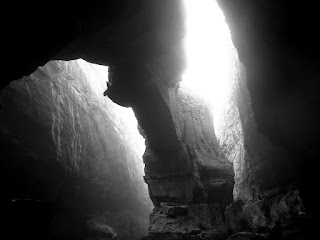
Descending through that crack turned out to be one of the most amazing experiences so far. It was like something out of an Indiana Jones movie, thankfully minus all the booby traps. We clambered over, under, and through boulders, sometimes squeezing through places barely big enough to accomodate my pack. Then it would open up and there would be an enormous arch in the middle of the gully. It was truly spectacular and unlike anything I have ever experienced before.

After about an hour, we emerged onto an area where we could see the trail we followed up the previous day right below us. The clouds had lifted from the valley by this time, and we could see the campground far below. Dave and I both had huge smiles on our faces as we gave each other a high five. We had made it.
A big thanks to George, Pete, Charles, Steve, Henry, and Sam for organizing search parties and keeping the campfire burning. That campfire made for some damn fine food when Dave and I ambled in, including my first ever candy bar between two pancakes.
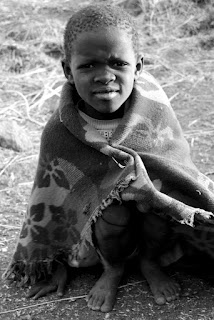
 unlike many other canned, "authentic" experiences offered to travelers. Kids would come out to watch us ride by, some shyly hiding in doorways, while the braver ones waved and shouted greetings at the top of their lungs in a sing-song chorus. Approaching villages was always amusing because our guide, Ephraim, would invariably give his pony a good kick, raise the stick he was using as a crop straight up in the air, and we would briskly trot through the village with as much pomp as we could muster. Once we got to the other side of the village we slowed down to a walk.
 The pictures tell more about the area than I ever could. Suffice it to say, I was completely enamored of the place.
 The village chief's hut in which we slept:
 Ketane scene:

 Looking down at a shepherd's hut perched on the edge of a river gorge:

 The ride back took us only four hours because we trotted and cantered almost the entire way (which I had to post or two-point because Chewbacca was so rough). I even got Dave up to his first gallop, another first for him which put a huge smile on his face. The entire trip was quite an experience for me, let alone for someone that had never ridden a horse.


 Three wrung necks and several down pillows worth of plucked feathers later, I found myself poised over a chicken like a surgeon, knife in hand. Luckily, one of the other fellows on the trip, Dave, has butchered a few chickens in his time, and he showed me what to do. Otherwise, I would have made some very bad decisions. Without going into the gory details, let's just say that there is a surprising amount of organic material inside a chicken. It all made for a quiet campground the following morning.


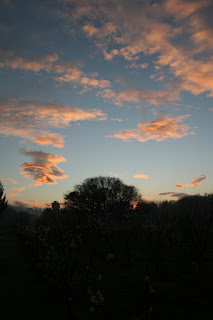
 It's a little town with a great bakery (hello sweet tooth) that I went to every day. Not just for sweets. but also the meat pies which were awesome and the equivalent of $1. Steak and Onion was my favorite. The women who worked there knew me quite well by the time we left.
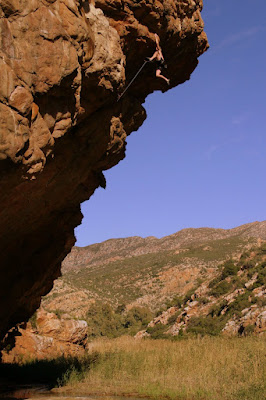 It was a farm/vineyard/campground/everything. A bit of a warren, there was an indoor climbing wall (small, but serviceable), stables (which had been converted to hostel type sleeping, then turned back into stables) where we cooked dinner on a gas stove while the horses munched hay (not sure having a stove in the barn is the best idea...), a kitchen for campers, rented bungalow type rooms, a separate kitchen for the paid rooms, random courtyards, etc, etc. And all very reasonably priced. I think it was the very hot showers that sold me completely, despite the fact that they had a hole cut into the wall at about head level. Definitely for ventilation and a bit of a breezy experience.
 That was certainly a first. Of course that didn't stop us from climbing. It was a little eerie, however, to look down at a corpse from the top of a crag. Bloat never looks good on any body. It was a bit like happening upon a car wreck -- you wanted to look and felt slightly dirty for doing so -- but it was unavoidable because you have to look down for feet placement when climbing. In reality, there really wasn't much to see. The body looked like a blue barrel (due to clothing, not the cold). Anyway, the authorities milled around for a couple of hours until some guys showed up and donned drysuits. I guess corpse retrieval was not in anyone else's job description. The new guys jumped in the pond, inelegantly backstroked their way to the body, and grabbed it with their glove encased hands. Once they hauled it to shore, they zipped it into a bodybag and all the authorities quickly left in a big, official looking posse. All that was left was the horror at realizing that our driver, Henry, drank some water from the stream before we happened upon the scene. Luckily, the flow was going away from the corpse, but still, huge ick factor.
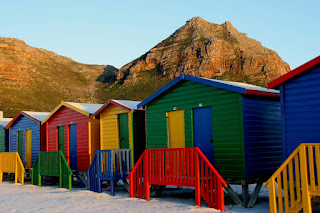 Muizenberg beach cabanas at sunset:
 I did my first three person multi-pitch one day and another little three pitch climb the next day.
 We were supposed to go climbing on Table Mountain, but it was too wet and the official plan was to rent a vehicle to take everyone into the city. Live everything else, we discovered it was not so easy.


